
Understand
Before trying to change a child’s behaviour, consider what that behaviour may be communicating and what has changed in the child’s world.
Little Bridges Global · The First 90 Days
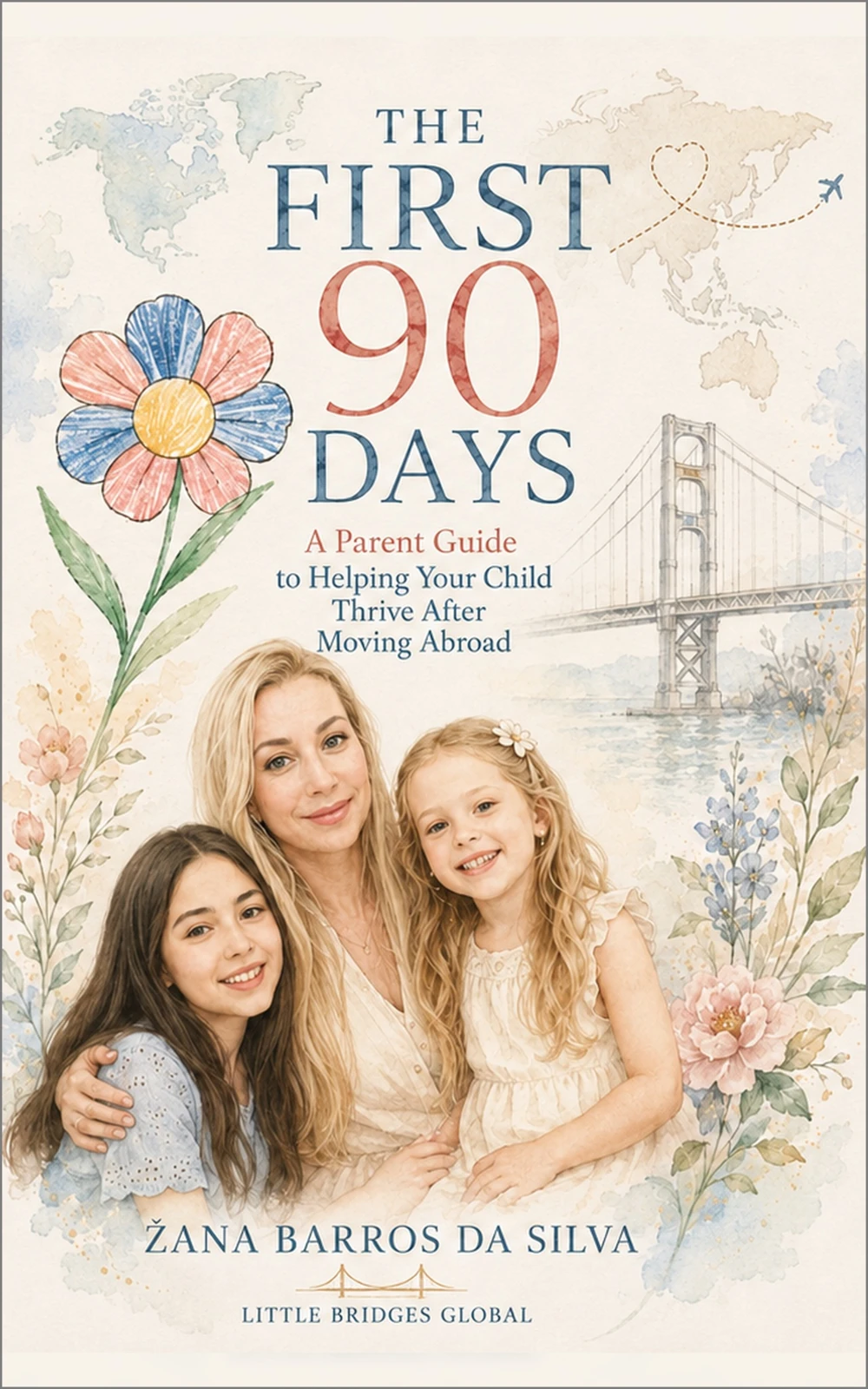
A Parent Guide to Helping Your Child Thrive After Moving Abroad
Moving abroad with children can be an exciting decision for a family. It can also be far more emotionally complicated than parents expect.
A new country may offer opportunity, adventure and a fresh start while a child is simultaneously missing friends, routines, familiar places and the life they understood before the move. Some children adapt relatively quickly. Others struggle from the beginning, while some appear settled at first and find things more difficult several weeks or months later.
The First 90 Days was written for parents who want to understand what may be happening during this adjustment period and know how to support their child in practical, thoughtful ways.
It is not a book about making children love their new country within ninety days, and it does not suggest that every child follows the same timetable. Instead, it looks closely at the first weeks and months following an international move and helps parents recognise the emotional, developmental and practical challenges that may arise along the way.
For adults, an international move often has a clear practical structure. There is a decision, a moving date, a journey and eventually an arrival.
For children, the psychological transition may be much less straightforward.
A child can enjoy their new school and still miss the old one. They can make new friends while continuing to grieve friendships they left behind. They may appreciate their new home while still feeling angry that they had little control over leaving the previous one.
Parents can find these mixed responses difficult to interpret, particularly when the practical side of the move appears to have gone well.
A previously confident child may become more anxious or dependent. Behaviour may change. School performance, sleep or friendships may become more difficult. A teenager may withdraw or resist becoming involved in the new environment.
These changes do not automatically mean that something is seriously wrong. They may form part of the child’s attempt to understand and adapt to a very significant change in their life.
Helping parents recognise that distinction is one of the central purposes of this book.

Most parents already know that they should be patient and supportive. What is much harder is knowing what that means in a particular situation.
Parents may find themselves wondering whether a child’s reaction is part of ordinary adjustment, whether they should encourage greater participation or reduce pressure, how much they should talk about the home and friendships left behind, and when a pattern deserves closer attention.
They may be unsure what to say when a child insists they want to go home, refuses to attend another activity, compares everything unfavourably with their previous country or blames the parents for making the move.
The First 90 Days addresses these kinds of situations by combining psychological understanding with practical guidance that parents can use in everyday family life.
The aim is not to provide a script for every possible difficulty, but to help parents understand the principles behind a child’s response so that they can make more confident decisions for their own family.
A four-year-old and a fifteen-year-old may live through exactly the same family move and experience it very differently.
Young children may respond strongly to changes in routine, familiar caregivers or surroundings even when they do not fully understand the wider meaning of the move.
Primary-school-aged children may become more aware of social losses, differences between schools and the friendships they have left behind.
Older children and teenagers may be managing relocation at the same time as questions about identity, friendship, independence and belonging become increasingly important.
For this reason, The First 90 Days considers different developmental stages rather than treating children as one single group.
The book includes age-sensitive guidance to help parents think more carefully about what a particular response may mean for the child in front of them.
The book looks at international relocation from both an emotional and practical perspective.
It explores the losses that can accompany moving, including some that adults may not immediately recognise. A child may lose not only friendships or familiar places, but also a sense of competence, independence, status, routine or confidence in an environment they previously understood.
It considers how uncertainty and stress may show themselves through behaviour and why emotional responses can sometimes emerge after the apparent excitement of the move has passed.
The book also explores school transition, friendships, identity, belonging, family relationships and the gradual process of developing a meaningful connection to a new place.
Throughout, the emphasis remains practical. Psychological concepts are included because they can help parents understand what they are seeing, but the purpose is always to bring that understanding back into ordinary family life.
The First 90 Days is grounded in psychological and developmental research rather than being based solely on personal opinion.
The book draws on established work relating to attachment, child development, adjustment, loss, identity and belonging. It also distinguishes between established evidence, theoretical frameworks, practitioner guidance and the practical ninety-day framework developed for the book.
Research provides an important foundation, but it cannot predict exactly how one particular child will respond to an international move.
For that reason, the book does not present a single formula for successful relocation. It encourages parents to observe their own child, consider their developmental stage and circumstances, and respond in ways that make sense for the individual family.
A practical framework runs throughout the book:
Understand. Steady. Connect. Belong. Act.

Before trying to change a child’s behaviour, consider what that behaviour may be communicating and what has changed in the child’s world.
Provide enough predictability, emotional safety and routine to help the child regain a sense of stability.
Protect the relationship between parent and child during a period when many other familiar relationships and environments may have changed.
Recognise that belonging develops gradually through relationships, experience and meaning. It cannot be demanded simply because the family now lives somewhere new.
Turn understanding into practical decisions that support the individual child and family.
The framework is not a rigid sequence. Families may move backwards and forwards between these areas throughout the adjustment process.
You do not need to wait until a child is visibly struggling before thinking about adjustment.
For families who are still preparing for an international move, the book helps parents consider what their child may need before departure, how to talk honestly about the move, what might be important to preserve from the old life and how to approach the early weeks in the new country.
Good preparation cannot remove every difficult emotion, nor should that be the goal. A child may still feel sad about leaving even when the move has been managed thoughtfully.
What preparation can do is give parents a clearer understanding of what may lie ahead and help reduce the pressure for the transition to appear successful immediately.
The book is equally relevant if your family has already relocated.
Perhaps your child seemed happy initially and has become more unsettled. School may be difficult. They may be comparing the new country constantly with the old one, asking to return, struggling socially or becoming more withdrawn at home.
There is no requirement to begin the book on the day you move or follow it according to a strict calendar.
The ninety-day structure provides a useful way of thinking about the early adjustment period, but children do not develop or adapt according to a deadline.
Parents can begin with the sections most relevant to what their family is experiencing now.
The title The First 90 Days does not mean that a child should be completely settled, happy or fully adjusted by day ninety.
Some children may begin to feel at home much sooner. Others may need significantly longer, particularly when the move has involved substantial loss, family stress, language change, difficult school experiences or additional developmental needs.
The first ninety days are important because they often contain many of the earliest experiences, relationships and routines through which a new environment begins to become familiar.
The book uses this period as a practical framework for parents, not as a psychological deadline for children.
Many emotional and behavioural responses following relocation form part of ordinary adjustment, but this does not mean that parents should ignore significant or persistent difficulties.
The book helps parents think about what they are observing and when it may be appropriate to seek additional professional advice or support.
It does not provide diagnosis and is not a substitute for individual medical, psychological, psychiatric or other specialist care when such support is required.
Žana Barros Da Silva

Žana Barros Da Silva is the founder of Little Bridges Global and is currently in the final years of her psychology studies at Klaipėda University.
Her academic interests include developmental psychology, child adjustment, ADHD, family transition, identity and belonging. She has also trained in Rapid Transformational Therapy through the Marisa Peer Academy in London.
Her interest in international childhood is informed by both research and lived experience. Born in Lithuania, Žana moved to the United Kingdom when she was young and later raised her children across several countries, including Brazil, southern Spain and the UK, before returning to Lithuania.
Those experiences contributed to many of the questions explored in The First 90 Days: why children within the same family may respond differently to relocation, why difficulties sometimes appear later, and what parents can do when love and good intentions do not automatically make a transition easy.
Personal experience is not presented as evidence for how other families will feel. Instead, it informed the questions Žana went on to explore through psychology, research and the development of Little Bridges Global.
The First 90 Days is written primarily for parents who are:
preparing to move abroad with children;
in the first weeks or months following an international relocation;
concerned that a child is struggling to adjust after moving;
supporting a child through a new international school;
trying to understand changes in behaviour following relocation;
parenting a child who misses their previous home, friends or country;
supporting an older child or teenager with questions about identity and belonging;
looking for research-informed guidance rather than simple relocation tips.
Professionals supporting internationally mobile families may also find the book useful as a parent-focused resource.
Paperback
For readers who prefer a physical copy they can return to, annotate and keep as a family reference.
For readers who prefer digital reading through Amazon Kindle.
The book is in English. Amazon displays current prices, delivery options and Kindle availability for your location.
International schools, employers, relocation companies and Global Mobility teams may wish to make The First 90 Days available to families as part of relocation or transition support.
Organisations can enquire about bulk copies. Quantity, destination and intended use will be considered when preparing an organisational quotation.
Institutional digital use and licensing are handled separately from ordinary consumer purchases. Little Bridges Global does not provide an unrestricted organisational PDF by default.
No.
Third Culture Kids are relevant to the wider discussion of international childhood, identity and belonging, but the book is primarily written for families navigating an international move.
The central focus is the relocation itself: what may happen during the first weeks and months, how adjustment can look at different ages and what parents can do to support their child.
No.
Parents preparing for a move can use the book to understand common challenges before they arise and think more carefully about how they want to approach the transition.
Yes.
The ninety-day structure focuses attention on the early adjustment period, but many of the issues explored in the book continue well beyond the first three months.
Families do not need to follow the book according to a strict calendar.
No.
There is no single adjustment timetable. Age, temperament, previous experiences, family circumstances, language, school environment and the nature of the move can all influence the process.
Yes.
The book draws on psychological and developmental research and includes references to the evidence and theoretical frameworks informing the discussion.
Research is used as a foundation, not as a way of claiming that every child will respond in the same way.
No.
It is an educational and practical resource for parents. Where there are significant concerns about a child’s mental health, development, safety or functioning, individual professional support may be appropriate.
International relocation changes more than an address.
For a child, adjustment may involve making sense of what has been left behind, rebuilding friendships and confidence, learning new social expectations and gradually developing a sense of belonging in a place that once felt unfamiliar.
The First 90 Days was created to help parents understand that process more clearly and respond with greater confidence, sensitivity and practical knowledge.